
As a leading provider of pad printing services in China, Junying offers customers comprehensive pad printing solutions that are specifically tailored to meet the requirements of die casting and metal component decoration. These solutions are offered to customers. When it comes to relief printing, pad printing is a type of printing in which an image is first etched or engraved onto a printing plate, which is also commonly referred to as the cliché or gravure cylinder. This type of printing is then put through the relief printing process. It is then mounted onto a silicone rubber pad, which makes use of this recessed image to transfer wet ink onto a substrate in a single, rapid impression.
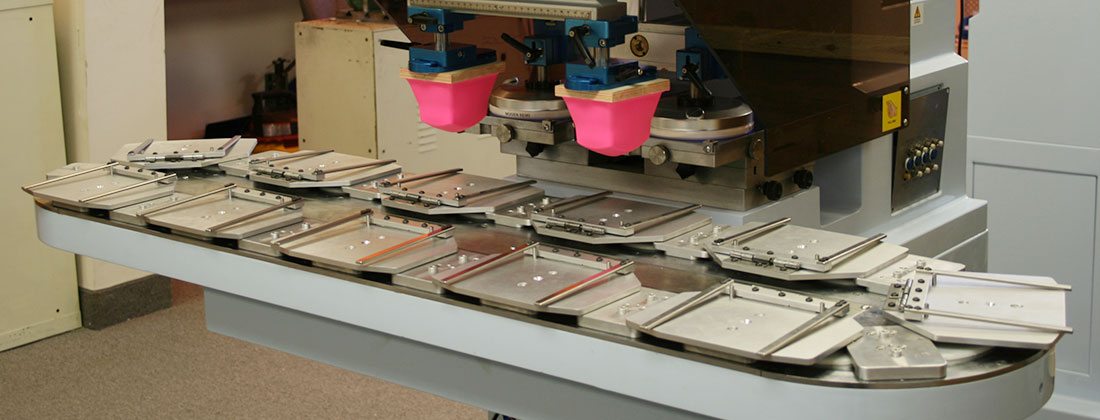
This process is repeated two times.
An engraving has been made on this cylinder. The ink is deposited onto the pad while the flooding stage is being performed. It is necessary to have multiple printing stations that are stocked with a wide range of pads and inks in order to be able to create intricate designs that feature multiple colors. If you want to achieve the smallest details possible, you can go as small as 0. It is especially beneficial to have prior experience working with a variety of metallic substrates, such as aluminum, zinc, and magnesium alloys, when it comes to perfecting the pre-treatment and post-finishing steps.
Immediately following the receipt of digital artwork files from customers, pre-press checks are carried out, and plates are then manufactured on-site with the assistance of precision milling machines. The integrated manufacturer Junying provides value-added services that extend beyond graphic decoration. These services are offered to customers. The entire process, from casting to CNC machining, secondary operations, and assembly, is carried out under one roof. In addition, stringent quality protocols are in place to guarantee that each batch can be traced back to its original source.
A Few Benefits of Using Pad Printing
The distinct advantages that pad printing provides in comparison to other methods of graphic application are the most important factors that contribute to the widespread use of pad printing:Inks can be deposited onto three-dimensional and difficult-to-reach surfaces using pad printing, which requires minimal foiling or obstruction compared to other printing methods. This comes in especially handy when it comes to compatibility with complex parts. Because of this capability, a wide range of color capabilities are possible. Pad printing continues to be a method that is cost-effective for production volumes that are short to medium. This can range from the production of small batches to the production of tens of thousands of units annually.
Specific Examples of the Applications of Pad Printing
Capitalizing on these strengths, pad printing has found widespread application across industries that deal with complex metal components and electronic devices, including but not limited to the following:The Electronics That Are Used in the Home:When it comes to mobile devices, cameras, USB drives, and other small appliances, the utilization of graphic personalization and identifying marks is beneficial. When it comes to ignition parts, gauges, and control panels that are utilized in the automotive industry, logos and indicators that are printed on long-lasting pad material offer protection as well as visual information. By utilizing graphics, it is possible for valves, sensors, and connectors in industrial equipment to acquire resistance to wear factors such as pressure, temperature, and chemicals. This resistance can be acquired through the use of illustrations.
To fulfill the requirements of branding, some examples of packaging materials include containers, bottles, and caps.
These materials feature designs that are multicolored and vibrant, and they are printed on metallic substrates. It is possible to achieve precise surface preparation by employing a multi-stage cleaning and pre-treatment process that is adapted to the composition of the component. Pad printing is a process that is carried out by employing the most recent flat bed and semi-rotary machines for the purpose of producing the highest possible quantities of products.
It is necessary to conduct quality control tests and obtain certification that are stringent and in accordance with the standards of both the client and the industry. The management of the logistics and packing process up until the point of delivery, in accordance with the schedules and consignments. production that is finished on time throughout the entirety of the order cycle, from small-scale sample runs to large-scale production as well as everything in between.